- Home
- About
Our story
A mine’s malaria problem became a national programme
AngloGold Ashanti Malaria Control (AGAMal) started in Obuasi in 2005 to protect mine workers and their families. Today it sprays homes across Ghana and manages Global Fund grants for the country.
Mission & values
Malaria-free communities
That is our vision. Our mission is to develop, implement and sustain public health interventions that are efficient, effective, economical and measurable.
- Goal
Reduce disease
Contribute to the reduction of diseases of public health importance, in line with national and international priorities.
- Value
Safety, health and environment
Every spray round, lab test and clean-up is planned around the safety of households, staff and surroundings.
- Value
Continuous improvement
Entomology, data and season reviews feed into how the next campaign runs.
- Value
Dignity and respect
Spray operators enter homes only with the householder’s permission and explain each step.
- Value
Prudence
Careful use of donor, government and company funds, with results reported back.
- Value
Partnership
We work with assemblies, health services, researchers and communities on every intervention.
History
Two decades of malaria control
From one municipality to 25 districts at its peak, and from company programme to Global Fund principal recipient.
- 2004
Malaria named the biggest threat
AngloGold Ashanti identifies malaria as the biggest public health threat to its operations in sub-Saharan Africa.
- 2005
The programme begins in Obuasi
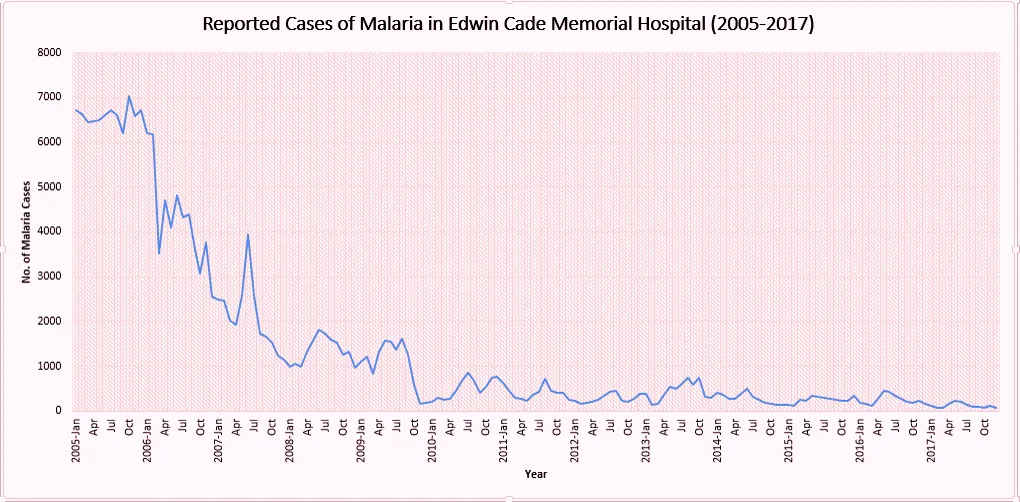
The mine hospital records over 6,800 malaria cases a month, 2,500 of them mine workers, costing 7,500 shifts a month. A comprehensive malaria control programme launches with a goal of halving malaria in Obuasi within two years of spraying.
- 2008
First private-sector Global Fund recipient
AGAMal receives a US$133 million Global Fund grant, as the first private-sector principal recipient, to scale indoor residual spraying with the Ministry of Health and National Malaria Control Programme.
- 2011
Spraying in 11 districts
IRS reaches four districts in Ashanti, one in Central, three in Western and three in Upper West.
- 2014
25 operational districts
Between 2012 and 2014 the programme grows to 25 districts across Ashanti, Central, Western, Northern, Upper West and Upper East regions. A national reprioritisation then focuses spraying on Upper West, where prevalence was above 50%, while Obuasi continues as AngloGold Ashanti’s own programme.
- 2016
New insecticides, new districts
Savings from the IVCC and Unitaid NgenIRS initiative fund expansion into three Upper East districts: Builsa North, Builsa South and Kassena Nankana West.
- 2024
Principal Recipient for community systems
AGAMal is selected to manage the Community Systems Strengthening component of Ghana’s Global Fund HIV, TB and malaria grant for 2024 to 2026.
The result
Monthly cases fell from thousands to a few hundred
AngloGold Ashanti has invested an average of US$1.5 million a year in the programme and has seen work absenteeism from malaria fall by over 90%.
The approach has been replicated at AngloGold Ashanti mine sites in Mali, Guinea and Tanzania.
Where we work
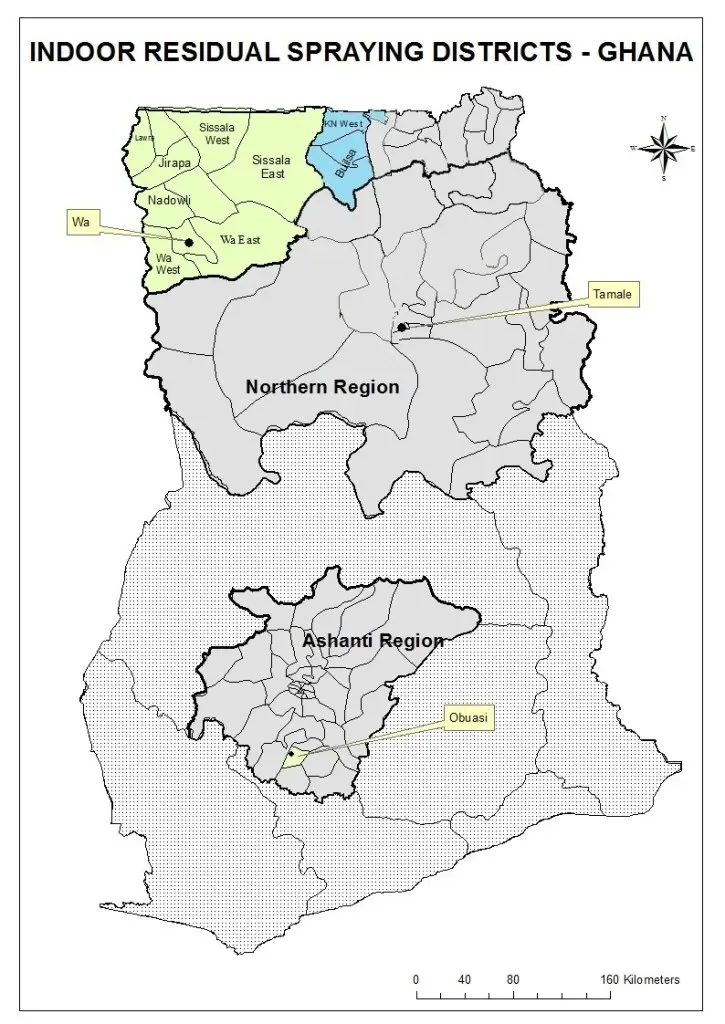
From Obuasi to the Upper West and Upper East
Spraying districts have changed with national priorities and funding. The map shows the operational districts in 2017.
Help us reach malaria-free communities
Volunteer in your community, partner with us on a programme, or see our open position.